
Product creative · 5 min read
Creating product photography without losing product truth
Let environments and compositions change while pack identity, materials and factual details remain controlled.
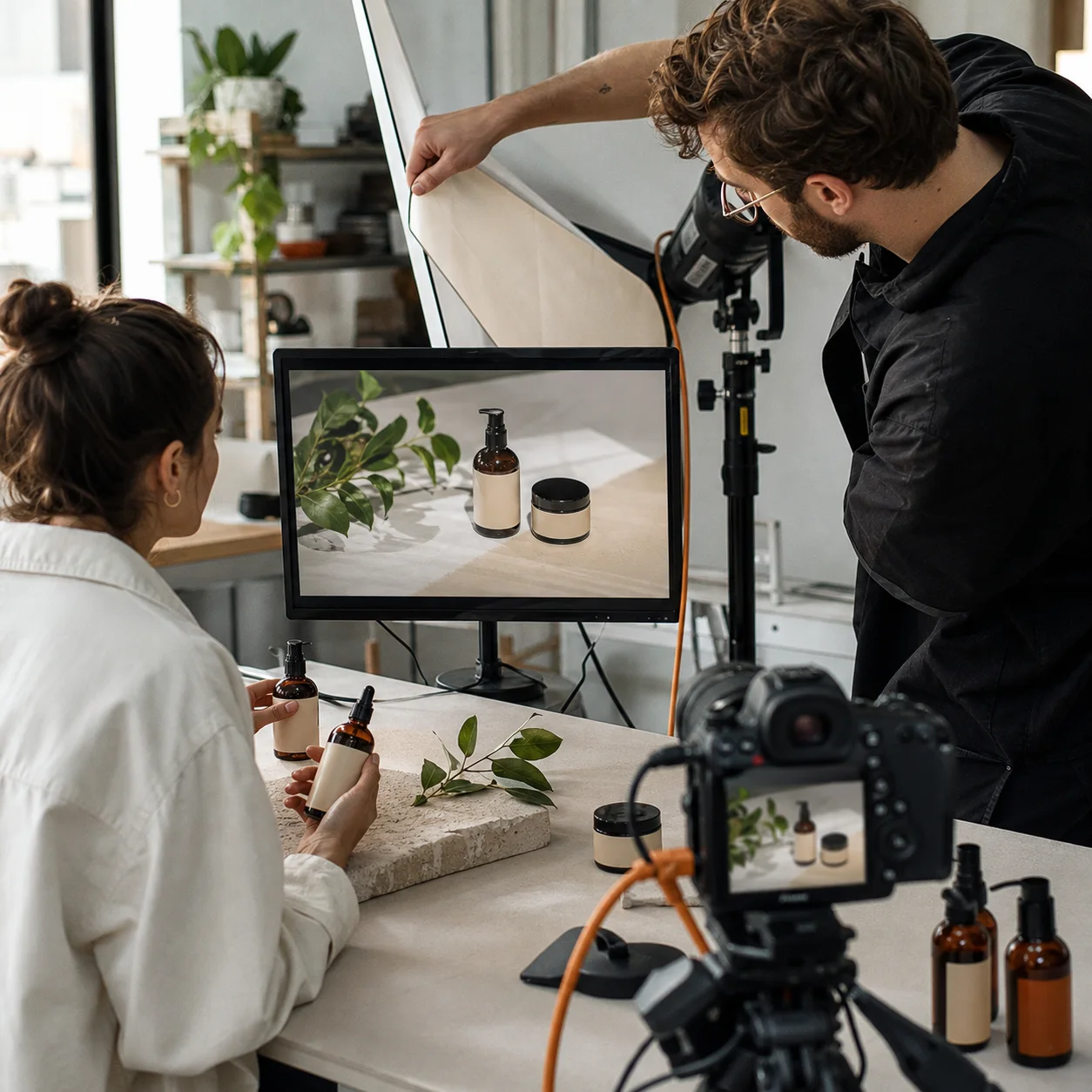
Generative production can create many product scenes quickly, but speed is not useful when the product changes shape, material, color or function. Product truth has to be designed into the workflow.
Teams need clean references, explicit invariants and a review method that compares the generated scene with the physical or approved digital product record.
Build the product truth set
Capture front, side, back and material details under neutral light, along with current pack variants and factual dimensions. Include notes for movable parts, fill level, transparency, reflections and the areas where text must remain unchanged.
This reference set becomes the baseline for both models and reviewers.
Separate identity from the scene
Define which product attributes are invariant and which environmental elements may change. Background, supporting props, camera angle and light can create the campaign route while pack geometry, closure, color and material remain controlled.
- Exact silhouette, proportions and pack components.
- Approved color, material, translucency and reflections.
- Label area, required marks and readable product facts.
- Permitted interactions, scale and use context.
Use generation and compositing deliberately
Some routes are best created by generating an environment and compositing an approved product render. Others can use product-conditioned editing when the model preserves geometry reliably. Select the method according to risk and required realism.
Keep the original reference and the generated or composited output side by side during development.
Review product truth as its own decision
A visually strong asset can still misrepresent a product. Assign a product owner to confirm pack, color, function and claim context before brand or market approval is considered complete.
Record corrections as reusable product rules so the next route begins with stronger context.
Define product invariants before generation
List the details that may not change: silhouette, material, label hierarchy, logo, closure, color, count, included accessories and current claims. Provide high-quality references from useful angles and identify which source is authoritative when packaging versions differ.
Separate invariant product truth from creative latitude. The scene, surface, camera, lighting and supporting props can change while the pack remains controlled. This gives creators room to explore without making fidelity a subjective final review.
- Current pack and approved variants.
- Shape, material and label details.
- Claims and factual exclusions.
- Allowed scene and composition changes.
Review fidelity at production size
Compare selected outputs with the source at the size customers will see. Check high-salience details first, then inspect typography, reflections, seams, edges and physical interaction. A visually polished image still fails if the product is not the one being sold.
Record corrections as structured product feedback. Repeated problems should update the invariant list, reference set or production method. Final approval identifies the exact version and the markets or placements where it may be used.
The operating principle
Build the system around the work.
Generative product photography works when the scene can change without changing the product. Treat product truth as a maintained source and an explicit approval decision.